
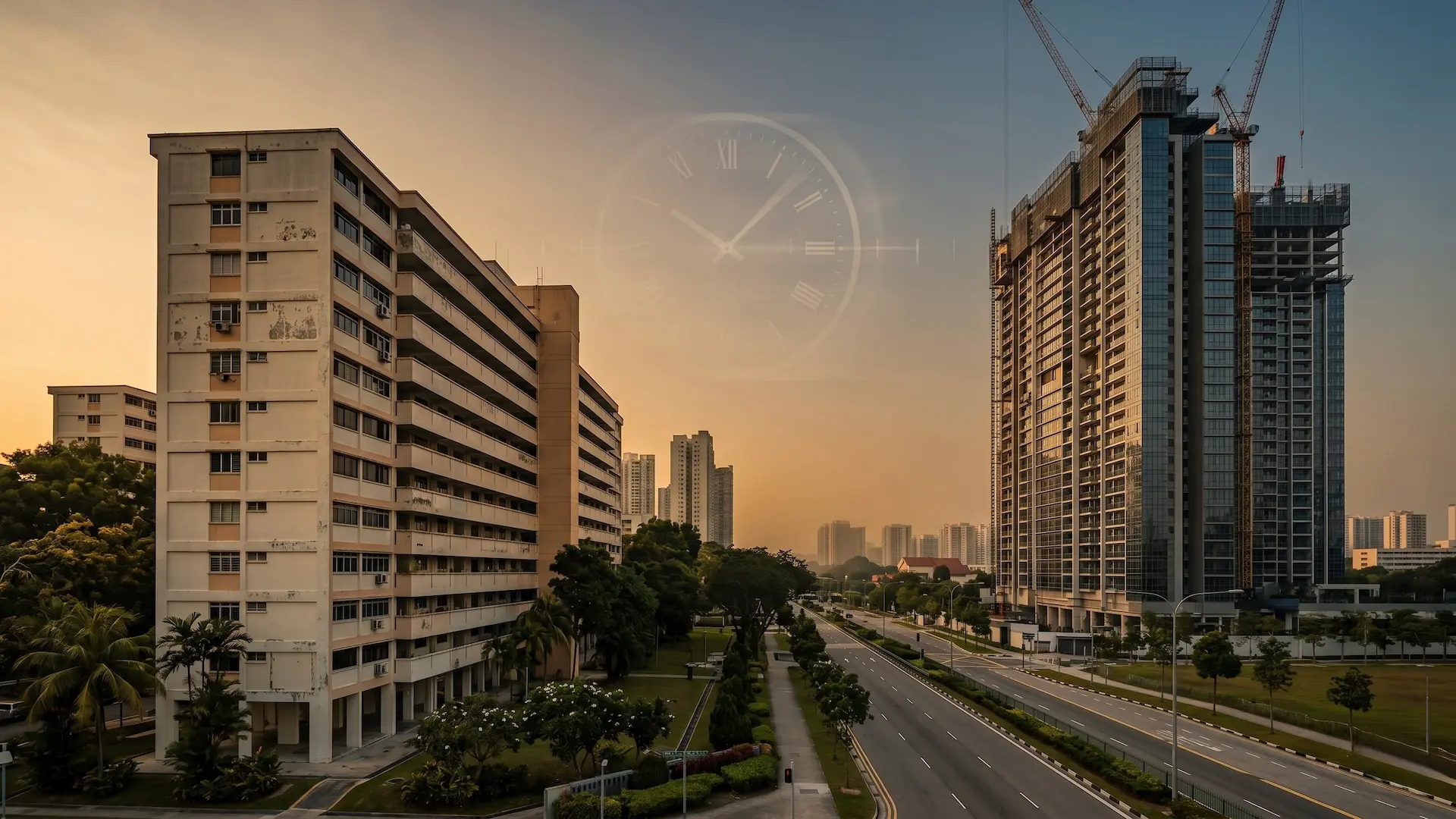
The Two Clocks Problem: Why New Launch Prices Lift Your 99-Year Leasehold Value
By Sam Tan | Dunamis Property
A strategic briefing for HDB upgraders weighing 99-year private property.
In this briefing. Why the 99-year lease clock is not the most useful clock to watch if you own a leasehold condo in Singapore — and why nearby new launches matter more than your lease year. Thirty years of data, twenty-eight condos, and a gap-reading framework you can apply to your own unit today. Strategic reading for owners and HDB upgraders.
You bought your HDB flat in 2010. Six hundred and fifty square feet, four-room, $450,000. Sixteen years later, agents tell you it's worth $850,000. Your eldest just enlisted, your youngest is in JC, and the upgrade conversation has come up at every family dinner for three years. You start looking at private new launch condos. The numbers are big. The promises are bigger.
At the showflat, the agent walks you through a 99-year lease, fresh from the developer. Brand new. Smaller footprint than your HDB but laid out beautifully. The numbers run high — $1.8 million for a two-bedder, $2.4 million for a three. The pitch lands easily: you've got value sitting in the flat, the lease is long, and the agent says you'll be looking at a comfortable exit in seven to ten years.
And the math feels intuitive. Ninety-nine years. That's practically forever — three generations of family time. You won't be around to see the lease end. Your children won't either. So what's there to worry about? Sign the option fee, settle the down payment, and you're set. Right? The agent says yes. The bank's loan officer says yes. The mood at home is excitement.
Not quite. The math the agent walked you through assumes the 99-year clock is the only clock in the equation. It isn't. There's another one. It's already been ticking for a long time, and most upgraders never see it on the price sheet.
Every 99-year leasehold property is a clock counting down. When you upgrade, you don't reset your housing clock — you start a second one. And the second clock costs more, runs faster on the value side, and compounds the loss on the first.
Table of Contents
1. The Two Clocks: One Lease, Two Different Speeds
Every 99-year leasehold property in Singapore is a clock. The day the lease was issued, the clock started. Every day since, it has been counting down. When the clock reaches zero, the lease ends. The land returns to the state, and the building on it stops being your property. This is not a controversial claim. It is the structure of every leasehold in Singapore — including yours.
Your HDB flat is a 99-year lease. If you bought it in 2010 directly from HDB, your lease started in roughly 2008 — let's say sixteen years have passed. Your flat now has eighty-three years left on the clock. If you bought it on resale, the clock has often been running for thirty, forty, even fifty years already. Most HDB owners know this number exists but rarely think about it. The flat feels permanent. The neighbours have been there for decades. Year by year, the lease counts down quietly — but it is real, and the HDB resale market prices it in.
When you sign for a private 99-year leasehold condo, the agent's pitch is that you are getting a "fresh" 99 years. And technically, that's true — the developer was given a fresh 99-year lease by the URA when they bought the land. But notice what "fresh" means here. It does not mean your time on this earth has reset. It does not mean the clock you spent the last sixteen years on has paused. It means a second clock has now started running alongside the first. You are now responsible for both.
This is where most upgraders' mental model breaks down. They think of the upgrade as a one-clock switch: trade in the old lease, get the new one. But the two clocks are not the same kind of clock. The HDB clock is connected to your housing equity — a place you've lived, paid down a mortgage on, watched appreciate. The new condo clock is connected to a separate stack of capital. Both leases age. Both eventually expire. Neither one waits for the other.
Why does this matter beyond the metaphor? Because the two clocks do not tick at the same speed on the value side. A 99-year lease loses value faster as it ages — not in equal annual slices, but in an accelerating curve. That is what the next chapter is about.
2. Why a 99-Year Lease Loses Value Faster Over Time
If a 99-year lease loses value over time, the simple version of the answer says each year, it loses one ninety-ninth of its value. One year passes, one slice gone. Ninety-eight years left. The next year, another slice. Easy to picture, easy to explain. There is just one problem: that is not how it works. A 99-year lease does not lose value in equal annual slices. It loses a little at the start, more in the middle, and a lot at the end. The shape of that loss is what this chapter is about.
The government itself has a table for working out what a lease is worth at any age. It is not a guess. Every time a leaseholder applies to extend their lease, the government calculates the top-up premium using this table. Property professionals call it Bala's Table, after a Land Office employee named Mr Bala who first put it together in the 1940s. Whatever you call it, valuers, banks, and government agencies all work from roughly the same curve. Here is what that curve looks like.
Look at the shape of the line. In the first forty years of the lease — from year 99 down to year 60 — the value drops by sixteen cents on the dollar. Then something changes. In the next thirty years — from year 60 down to year 30 — the value drops by twenty cents. Bigger loss, shorter time. In the next twenty years — year 30 down to year 10 — the value falls by thirty cents. Thirty cents lost in twenty years. The line is no longer drifting downward. It is falling.
Why does the curve speed up? Two reasons, working together. The first is what buyers feel. A fresh 99-year lease feels close to forever. A 30-year lease is a clock the buyer can see ticking — and the next buyer after them sees an even shorter one. Each remaining year matters more because there are fewer of them left. The second reason is what banks and CPF allow. As a lease gets shorter, banks tighten the loan — smaller mortgage, shorter repayment period. CPF rules also tighten: a shorter lease means you can use less of your CPF to pay for the flat. So as the clock runs down, the next buyer can borrow less and pay less. The financing rules push in the same direction as the feeling, and together they make the line bend down hard near the end.
That is the curve the government, the valuers, and the banks all work from. It is the official answer to the question: how much does a 99-year lease lose, and when? But it is a theoretical answer — the shape of the line on paper. The next question is whether private 99-year condos in Singapore have actually behaved this way over the past twenty years. The data either confirms the theory or breaks it. Chapter 3 takes the question to the URA caveats.
3. What 30 Years of Real Singapore Sales Say About the Bala Curve
If you own a 99-year leasehold condo in Singapore, here is what nearly 20,000 real sale transactions actually show: for as far as the data goes — more than 30 years of resale history across 28 condos — prices have generally drifted UP from where they started, not down. That probably surprises you, because the property pages have been telling you the opposite for years.
The reason the property pages tell you the opposite is something called the Bala curve. Most property articles toss the term around without telling you what it really is. So before we go any further, here is what it actually is. The Bala curve is NOT a forecast. It is a government formula. The Singapore Land Authority uses it for paperwork: calculating stamp duty when a property changes hands, pricing the cost of a lease top-up when an owner wants to extend an old lease, and working out the bill when a 99-year leasehold development goes en-bloc. Banks and valuers use it for the same kinds of paperwork tasks. For those uses, the curve is doing the job it was designed to do. The SLA and the banks are not wrong to use it.
The misuse happens further downstream, in property commentary. Articles, forums, and YouTube property channels regularly cite the Bala curve as if it predicts how much your leasehold condo will be worth ten, twenty, or thirty years from now. The curve was never tested as a market price forecast. It was never meant to be one. And when you check it against the actual Singapore market — every sale, every year, every condo we have data for — the predictions simply do not match what the market did.
The oldest 99-year leasehold condos in Singapore still have more than half their lease left, and in every single year of data we have, lease decay has not shown up the way property articles have been claiming the curve predicts. What happens at the very end of a 99-year lease — when fewer than 40 years are left — is a question Singapore does not yet have data to answer, because no private leasehold condo has gotten there. But for the years your condo has actually been transacting, and for the years you are likely to own it, the panic was based on the wrong reading of the wrong tool.
Look at the chart above. Every grey line is one condo. The three coloured lines — red for Bayshore Park, blue for Mandarin Gardens, orange for Ivory Heights — are the three oldest 99-year leasehold condos in Singapore for which we have transaction data going back to the mid-1990s. Bayshore Park and Mandarin Gardens both started selling in 1982. Ivory Heights started in 1986. These three are the only ones old enough to take their stories deeper into the lease than any other condo on the chart.
All three lines start at the left side of the chart at a value of 100. That is the baseline — whatever the median price was in each condo's first recorded year of sale, we set it to 100 so we can compare condos that started selling at very different times on the same chart.
Now follow each coloured line from left to right. They start at 100. They dip briefly in the late 1990s, which is around 75 to 80 years remaining on the lease — that dip is the Asian Financial Crisis of 1997 to 1998, not lease decay. Then they climb. Steadily. For decades. By the time the lines reach the right edge of the chart, Bayshore Park is sitting at about 190, Mandarin Gardens at about 220, and Ivory Heights at about 336. In plain numbers, the median resale price at Bayshore Park is roughly twice what the first owners paid for a comparable unit. At Mandarin Gardens, roughly two and a quarter times. At Ivory Heights, more than three times.
Now look at the dashed grey line cutting across the chart. That is what the Bala curve predicts. It says a 99-year leasehold, starting at 100 with a full lease, should already be at about 95 with ten years gone, about 89 with twenty years gone, about 80 with forty years gone. It should drift downward steadily as the lease ticks down. At every observable year on the chart, every one of the 28 condos in our dataset sits ABOVE where the Bala curve says it should be. Not slightly above. Far above. By the time the curve has drifted down to roughly 80, the average condo in the dataset is sitting somewhere between 150 and 250, and the three coloured anchors are sitting between 190 and 336.
The gap between what the curve predicts and what the market actually delivered IS the visual argument of this whole article. The Bala curve is a useful regulatory tool for paperwork. As a forecast of what your condo will be worth, it has never been right in any year of any condo in this dataset.
Now an honest qualifier. Look at the right edge of the chart. The coloured lines stop. That is because the chart runs out of data at about 55 years of lease remaining for Bayshore Park and Mandarin Gardens, and 60 years remaining for Ivory Heights. The oldest 99-year leasehold private condos in Singapore still have more than half their lease left to run. What the Bala curve predicts for the very late stages of a lease — when fewer than 40 years are left, when fewer than 30 are left, when fewer than 20 are left — is something we cannot verify or refute from Singapore market data, because no private 99-year leasehold condo has reached those years yet. The curve might end up being right about those late years. It might not. We will start finding out somewhere around 2055, when Bayshore Park and Mandarin Gardens cross into territory no Singapore condo has been before.
What we CAN say with certainty: for the years your condo has actually been transacting, and for the next ten or twenty years you are most likely to own it, the popular reading of the Bala curve was wrong. The market did not behave that way. It did not behave that way for any of the 28 condos in this dataset. It did not behave that way in any of the 19,720 transactions we examined.
How we built this chart. We pulled every recorded sale of every private condo on a 99-year or 100-year leasehold tenure that first transacted in Singapore between 1982 and 2019. The source is URA REALIS, the official caveat database. That gave us 19,720 individual sale transactions across 28 condos. Three of those 28 — Ivory Heights, Tanamera, and Harbour View Towers — were added specifically to fill a gap in the 1986-to-1990 vintages, so that the chart did not skip a decade. For each condo, we computed the median price per square foot for every calendar year, then set that condo's first-year median to 100 and tracked how the price index moved from there. This way, a 1982 condo and a 2019 condo can sit on the same chart without inflation distorting the comparison, because each line is measured against its own starting point. The Bala curve overlay uses the Singapore Land Authority's published lease-decay table, rescaled so that the 99-year-remaining value equals 100 (matching the empirical baseline).
4. The Owner's Clock: Why New Launch Prices Lift Your Resale Value
Finding. Most Singaporeans don't hold their condo until the lease runs out — they sell after 8 to 12 years, because the new launch nearby got expensive enough that upgrading made sense. The clock that actually matters isn't the lease counting down. It's the new launch prices counting up — and as those prices climb, your unit's resale value climbs with them.
The Owner's Clock Runs Faster Than the Lease
Most Singaporeans who buy a condo do not hold it for 99 years. They do not hold it for 50 years either. The typical holding period before selling is 8 to 12 years. This is true across resale data going back decades. The lease may still have 80 or 90 years left when they sell. The lease running down is not why they leave. Something else is moving them.
When you sign for a 99-year condo, the natural thought is: "I have decades. The lease will outlive my mortgage. Plenty of time." That part is true. But it sets up a wrong expectation about how long you will actually keep the unit. The data says you will probably sell long before the lease becomes a worry. Not because anything goes wrong. Just because life moves, family grows, work changes, and at some point selling and moving makes more sense than staying put.
The most common reason owners sell after 8 to 12 years is not panic about the lease. It is upgrading. The kids are older and the unit feels small. The husband and wife both got promotions and the household income has doubled. Or — and this is the one we want to look at closely — a new launch project came up in the neighbourhood, and the gap between what your unit is now worth and what the new launch costs has reached the point where the upgrade math works. Your unit has gone up enough in value. The new launch is more expensive than your old one, yes, but not so much more that you cannot stretch to it. So you sell, take the proceeds and a fresh loan, and move into the new project.
This matters because every conversation about leasehold condos starts with the wrong clock. People worry about year 50, year 60, year 70. But the owner sitting in the unit is almost never the same person at year 50 as the one who bought it. Most owners are out by year 12. The clock that matters for the person buying the condo today is the owner's own holding clock — and that clock runs much faster than the lease clock.
For the buyer who specifically wants to opt out of this owner's-clock mechanism altogether, freehold launches sit in a different framework. A project like Arina East Residences in Tanjong Rhu carries no lease counting down, which means its resale value over a 20-year horizon does not depend on nearby new-launch pricing lifting the floor — the tenure premium is structural, not derivative. The trade-off: the buyer pays for that certainty upfront via the freehold premium, accepting a higher entry quantum in exchange for removing the lease variable from the long-term equation.
The Rising Floor: Why New Launch Prices Lift Your Resale Value
If owners are selling after 8 to 12 years, the next question is: what tells them the time has come? It is not the calendar. Nobody marks a date on the wall. The signal comes from outside the unit, from the new launches going up around it.
Here is what happens. A piece of land near your condo gets sold to a developer. The land price is higher than it was the last time a nearby plot changed hands. The developer is paying more for the land, more for construction, more for materials. So the new launch that goes up on that land has to be priced higher — the developer needs to make the project work. The new launch opens at, say, $2,400 per square foot. The launch before that, three years ago, opened at $2,000. The one before that opened at $1,750. Each new launch sets a new floor for what fresh-from-the-developer property costs in your neighbourhood.
Your resale unit does not sit untouched by this. It moves up with the floor. Not by the full amount — a resale unit is older, the finishes are a few years dated, the layout was designed for the market of ten years ago. So your unit trades at a discount to the newest launch. But the discount stays roughly proportional. When the newest launch is at $2,400, your unit might be at $1,800. When the newest launch climbs to $2,700, your unit climbs to maybe $2,050. The gap stays. The whole staircase moves up together.
This is the clock that actually drives the owner's decision. At some point the staircase has moved up far enough that the gap between your unit's resale value and the newest launch is small enough to bridge with a fresh loan. That is the moment the upgrade math works. Not before. Sometimes the gap is too wide for years and the owner sits tight. Sometimes a particularly hot launch cycle pulls the staircase up sharply and the math works after only six or seven years.
The chart below shows this in action. It tracks the median resale price for private non-landed 99-year leasehold condos across Singapore, year by year, from 2015 to 2024. One line, climbing. This is your unit. Every step up came from a new launch nearby asking more — and the agent had a number to point at.
Over the same ten years, the median new-launch price in Singapore's suburbs roughly doubled, climbing from around $1,170 per square foot in 2015 to past $2,200 by 2024, according to URA quarterly releases. The resale line in our sample rose alongside it — not as fast, but in the same direction, dragged up by the floor that moved first.
The line above tracks the median resale price per square foot across 28 leasehold condominium projects, year by year, from 2015 to 2024. The data comes from 5,917 individual sale records lodged with the Singapore Land Authority — every single resale transaction across these 28 projects, no cherry-picking. New sales and sub-sales were left out, because the question is what resale buyers actually paid. The sample grows from 13 projects in 2015 to 25 in 2024 as later projects entered their resale stage.
The Generational Clock: When the Unit Outlives the Owner's Decision
So far we have talked about the owner selling. But some owners do not sell. They buy a condo, raise the family there, and decide they like the place enough to stay. Twenty years pass. Thirty years pass. The kids grow up and move out. The unit is still there. At some point the owner is older, the unit is older, and a question comes up that nobody asks at year five: what happens when this is passed to the children?
This is a different clock from the owner's holding clock. It is the family clock. And it runs on a longer timescale.
When parents pass a leasehold condo to their children, the children inherit whatever lease is left. If the parents bought new at year 99 remaining and held for 35 years, the children inherit a unit with 64 years left. That is still a long lease — longer than most mortgages, longer than most working careers. The children can live in it, rent it out, or sell it. The unit has not become worthless. It has just become older, and so has the lease.
But here is the part the popular story gets wrong. The chart in Chapter 3 showed that, across the entire window we can observe, prices have generally drifted up over time. A unit handed down with 64 years left is not the same as a unit handed down with 99 years left — the new launches near it will still be setting a rising floor, and that floor lifts what the inherited unit can fetch on resale. The lease number on paper is smaller. The price floor underneath the unit may not be.
What this means in practice is that the generational pass-through is not a tragedy of a shrinking lease. It is the same rising-floor mechanism playing out over a longer window. The children are not inheriting a melting ice cube. They are inheriting a unit whose value still moves with the staircase around it — for as far as the data can see.
Three angles, one clock. Most owners sell after 8 to 12 years, not because the lease is shrinking but because a new launch nearby has lifted the floor under their unit far enough to make upgrading worth doing. The owners who do not sell still benefit from the same rising floor, year after year, as the staircase around them keeps climbing. And the unit that eventually gets passed to the next generation does not arrive at the children's door as a melting asset — it arrives as part of the same staircase, just further along it.
The question worth asking is not how much lease is left. It is how the gap between your unit and the nearest new launch is moving.
5. How to Read the Gap
Why the gap is the line worth watching
For most of this article, we have been looking at two things at once. The lease curve, which says your unit should be losing value every year. And the resale market, which shows your unit has been doing the opposite — drifting up, year after year, for the whole stretch we can actually see in the data.
That gap between what the curve says and what the market does is real. But it is not the most useful gap to watch if you own a leasehold unit today.
The more useful gap is the one we ended Chapter 4 with. The gap between resale prices and new-launch prices.
Chapter 4's chart shows the resale floor climbing steadily for the whole stretch we can actually see in the data. New launch prices climbed faster the whole way. The gap between them is the gap this chapter teaches you to read.
Here is why this gap matters more than the lease curve.
The lease curve was built to do a specific job — calculate stamp duty on leasehold transactions, price lease top-ups, settle paperwork for en-bloc sales. For those jobs, the curve works. It does what it was designed to do. But the curve was never built to forecast what your unit will sell for in ten or twenty years. That is not its job, and the data in Chapter 4 shows it has not been doing that job well either.
The gap between resale and new launch is doing a different job. It is showing you, in real money, how much the market is willing to pay for new stock versus older stock right now. It is a price signal, not a formula. And unlike the curve, it moves.
When the gap is small, resale and new launch are trading close. The market is treating older stock as roughly comparable to new. When the gap is wide, the market is paying a premium for new — and by the same logic, asking a discount for old.
The size of the gap, and the direction it is moving in your area, tells you something about where your unit sits in the market today. The lease curve does not tell you that. It cannot. It is the wrong tool for the question.
So for the rest of this chapter, we put the curve down. The gap is the thing to watch.
How to read the gap for your own unit
So how do you read the gap for your own unit?
You read it at three scales. District. Project. Unit. Each scale answers a different question, and you want to know all three before you make any call about where your unit sits.
District scale — is your district keeping up?
Start wide. Look at the average price per square foot — the psf — of new launches across Singapore over the last few years, and compare it to the average psf of resale. If new launches are pulling ahead nationally, that is the picture from Chart 4.2. Now narrow it to your district. Is your district keeping pace with the national new-launch trend, or falling behind?
A district that is keeping pace tells you the market still sees value in that area. New launches there are pricing as if buyers will pay up. Resale in that area is being pulled along with it. A district that is falling behind tells you the opposite — buyers are willing to pay for new stock somewhere else, not here.
You can check this yourself on the URA website. Look at the average transacted psf for new sales versus resale in your district, year by year. The data is free. The story it tells you is real.
Project scale — is your project being priced like new, or like old?
Next, narrow to projects of similar age in your area. If there is a new launch within walking distance of your block, that is the cleanest comparison. What is it transacting at, in psf? And what is your project transacting at?
If your project is transacting near the new launch psf, the market is treating your unit as close to new — even though your lease is older and your fixtures are not the latest. That is a strong signal. It means location, layout, or both are doing the work that age would normally pull down.
If your project is transacting at a meaningful discount to the nearby new launch, the market is asking for the discount. That is also a signal. The gap is the price of being older stock in that specific pocket.
Compare like with like as best you can. A 99-year leasehold project compares more cleanly to another 99-year leasehold new launch than to a freehold one. A four-bedroom layout compares more cleanly to other four-bedrooms. The more apples-to-apples your comparison, the more honest the gap.
Unit scale — what is your stack telling you?
Finally, narrow to your own unit. Within your project, units are not equal. A high floor with an unblocked view transacts higher than a low floor facing the carpark. A corner stack with cross-ventilation transacts higher than an internal stack. The same project can contain a unit on the right side of the gap and a unit on the wrong side of it.
Look at the most recent transactions in your stack, or the closest stack to yours. Compare those to the most recent transactions in the new-launch nearby. That number — the difference, in dollars — is the gap for your unit, right now.
It is not a forecast. It is a snapshot. But it is a snapshot of where the market actually is, in real money, for stock that looks like yours.
Three scales. District. Project. Unit. Each one tells you something the other two cannot. Together, they tell you which side of the gap your unit is on.
What right-side and wrong-side actually mean
So you have read the gap at all three scales. Now what?
There are two ways the gap can sit for your unit. Either the gap is narrow — your unit is trading close to nearby new launches, the market is treating it as close to new. Or the gap is wide — your unit is trading at a meaningful discount to nearby new launches, the market is asking for that discount.
These are not good news and bad news. They are different situations that call for different thinking.
If your unit is on the narrow side of the gap.
The market is paying up for your stock. Whatever combination of location, layout, view, or stack is doing the work, it is working. The age of your lease and the age of your fixtures are not pulling the price down the way the lease curve would predict.
This is the situation where holding is usually the easier call. Your unit is being valued like a much younger one. You are getting paid for that, every year, in the price the market is willing to set. Selling now means giving up something the market is currently giving you for free.
It does not mean never sell. Life events, portfolio decisions, upgrading plans — these can still make selling the right call. But the gap is not telling you to sell. The gap is telling you the market likes what you have.
If your unit is on the wide side of the gap.
The market is asking for a discount. Something — maybe several things — about your unit is not keeping pace with what nearby new launches are offering. The lease, the layout, the floor, the stack, the facing, the project's facilities, the walk to the MRT. Any combination of these can put a unit on the wide side.
This is the situation where the decision needs more care. The discount is real. It is the market telling you, in current money, what it thinks your unit is worth relative to new. Holding through a widening gap means absorbing that discount for longer.
But selling is not automatic either. Where you would move to matters. What you would buy with the proceeds matters. Whether the gap in your area is widening or stabilising matters. A wide gap that is stable is a different situation from a wide gap that is still opening up.
The wide-side decision is harder because the right answer depends on facts outside your unit. The narrow-side decision depends mostly on what is inside your unit.
The honest part.
Reading the gap once is a snapshot. Reading it well — across district, project, and unit, with the right comparables, in the right time window — takes work. It also takes someone who is doing this every week, not once every five years.
That is what a property advisor does. Not predicts where prices will go. Not promises which side of the gap your unit will be on next year. But reads the gap honestly, against the right comparables, and tells you what it is saying right now.
The lease curve will keep telling you your unit is losing value every year. The market, as Chapter 4 showed, has been telling a different story across the whole stretch we can see. The gap is where the market's story lives. Reading it is the work.
The Dunamis Verdict. The 99-year leasehold is not the melting ice cube the popular story makes it out to be. Thirty years of Singapore data say so, across 28 condos and nearly 20,000 transactions. The lease clock ticks. The market does not follow it down — at least not yet, not anywhere we can see in the data.
What moves your unit's price is the other clock. New launches near you set the floor. Every time a developer pays more for land and prices a fresh project higher, your unit moves up the staircase with it. That has been true for the whole stretch of Singapore data we can observe.
So if you own a 99-year leasehold condo, stop watching the lease number. Watch the gap. The gap between what your unit is worth today and what nearby new launches are asking is the real signal. Narrow gap means the market is paying up for your stock. Wide gap means the market is asking a discount. Either way, the gap moves with the market — the lease curve does not.
And if you are an HDB upgrader looking at a new launch, the same logic runs in reverse. The new launch you are looking at sets the floor for the next resale buyer, eight to twelve years from now, who will be looking at the new launch after yours. Your exit price is not set by your lease year. It is set by the staircase that will be standing around your unit when you decide to sell.
Reading the gap honestly, against the right comparables, in the right time window — that is the work a property advisor does. Not predicts the future. Reads the present, clearly.
Decision Tools
Run the Numbers Before You Decide
Three free calculators. No sign-up. Decode your affordability, cashflow, and transition in sequence.
Can I Afford This Condo?
Stress-test your TDSR, minimum cash, and ABSD before you commit.
Open CalculatorWhen Do I Pay What?
Map your progressive payment schedule for new launch condos.
Model CashflowSell HDB or Buy Condo First?
Time your transition to avoid ABSD and bridging loan exposure.
Open MatrixSpeak Directly With the Founders.
Many of our clients prefer an immediate, private conversation to discuss their portfolio. Tap below to connect directly with Sam and Lisa to strategise your next move.
Frequently Asked Questions
99-Year Leasehold FAQ: Lease Decay, Resale Value & The Bala Curve
A 99-year leasehold property in Singapore is a unit where you own the right to live in or rent out the home for 99 years from the lease start date. After that, the unit and the land go back to the State. Most condos in Singapore are 99-year leasehold, not freehold. The 99-year clock starts on the day the lease is issued by the State, not the day you buy. So a brand-new launch usually has 99 years on the clock, and an older resale unit has whatever is left of the original 99 years.
The lease curve says yes. The data says not really, at least not in the way most people think. Our research looked at 30 years of real Singapore condo resale prices, covering units with anywhere from 99 years down to 55 years left on their lease. Across that whole stretch, prices have generally moved up, not down. The Bala curve, which is the formula many people use to predict leasehold decline, has been pointing the wrong way the entire time. What happens once a unit has fewer than 55 years left is a question the market has not yet answered. Worth checking again around 2055.
The short answer is no, and not because the curve is wrong — but because it was never built for that job. The Bala curve is a Singapore Land Authority formula. It does a real job, and does it well: stamp duty on leasehold transactions, lease top-up pricing, differential premium for en-bloc sales, and bank valuation paperwork. For those uses, the curve is doing exactly what it was designed to do. The misuse happens in property articles, forums, and YouTube channels that point to the curve and say "this is what your unit will be worth in 20 years." That use was never validated. The curve was not meant to forecast market prices.
Not as cut-and-dried as the comparison suggests. Freehold condos in Singapore trade at a premium, usually around 10 to 20 percent above similar leasehold units in the same area. That premium is the price freehold buyers pay for not having a lease clock. Leasehold trades at a discount, and that discount is real. But the empirical question is whether leasehold values have actually fallen in line with the curve's prediction. The answer, across 30 years of Singapore data, is no. Most leasehold condos have appreciated in absolute price over the observable window. The honest comparison is not leasehold versus freehold abstractly. It is your specific unit versus nearby new launches of similar type and tenure.
When the 99 years run out, the unit and the land go back to the State. The owner receives no automatic compensation, and the building is usually slated for redevelopment. This is the worst-case end-state. But it is also a 2080s or 2090s question for most condos currently being bought or sold today. For a unit with 70 or 80 years left, the lease-end question is not the one to think about first. The question that actually moves your unit's resale value over the next 10 or 20 years is the gap between resale and new launch prices in your area. That gap is the practical thing to watch.
For private condos, no. There is no legal route to convert a 99-year leasehold private condo to freehold tenure. Leasehold and freehold are different forms of land tenure decided at the time the State sells the land. A private condo on a 99-year leasehold plot will remain 99-year leasehold for the life of that lease. The only way the tenure changes is if the development goes through an en-bloc sale, the land is sold back to the State or a new buyer, and a fresh lease is issued on a new development. The Dubai-style conversion paths some search results mention do not apply in Singapore.
Read the gap, at three scales. First, district scale. Compare the average new-launch psf in your district to the resale average. If your district is keeping pace with the national new-launch trend, the market still sees value there. Second, project scale. Find a recent new launch within walking distance of your block. If your project is transacting close to its psf, the market is treating your unit as close to new. If your project is at a meaningful discount, the market is asking for that discount. Third, unit scale. Within your project, your specific stack, floor, and view matter. The most recent transaction in your stack tells you where your unit actually sits right now.
The honest answer is that the lease-clock alone is not the right trigger. Most leasehold owners over-anchor to the years remaining and miss the bigger signal. The signal worth watching is the gap between your unit's resale psf and the psf of nearby new launches. When that gap is narrow, the market is treating your stock as close to new, and you are usually being paid to hold. When that gap is wide and widening, the market is asking for a discount, and holding through it means absorbing that discount. Life events still matter. Portfolio needs still matter. But the gap, not the lease curve, is the more practical thing to watch.